
Fire Hydrant System Professionals
If your property has a private fire hydrant, California law makes you responsible for it. That means annual inspections under NFPA 25 and a full flow test every five years under California Title 25 — documented, certified, and available for review by your Authority Having Jurisdiction (AHJ) or insurance carrier.
Red Beacon Fire & Electric is a C16 licensed fire hydrant flow testing contractor serving commercial, industrial, and multifamily properties across Southern California and Arizona. We perform fire hydrant flow tests to NFPA 291 standards, produce certified reports, and handle AHJ documentation directly — so you can demonstrate compliance without the administrative burden.
Call 855-202-2966 or request a free quote below. Fast response for SoCal and Arizona properties.
Contact us today for a free quote. Fast response times!
Our Fire Hydrant Services
- Annual Fire Hydrant Inspections, Testing & Assessments
- Pressure Test
- Flushing
- Installations
- Gasket Replacement
- Water Valve Maintenance
- Hydrant Repair & Restoration
- Fire Hydrant Flow Testing
What is a Fire Hydrant Flow Test?
A fire hydrant flow test — also called a fire flow test — is a field measurement that determines how much water your hydrant system can deliver at usable firefighting pressure. It's the standard method used to verify that your water distribution system can support fire suppression operations, fire sprinkler system design, or new construction permit requirements.
The test is governed by NFPA 291: Recommended Practice for Fire Flow Testing and Marking of Hydrants. Results are used by property owners, AHJs, fire protection engineers, and insurance carriers to evaluate water supply adequacy and system condition.
The Three Measurements: Static Pressure, Residual Pressure, and Flow Rate
Every NFPA 291 flow test captures three data points:
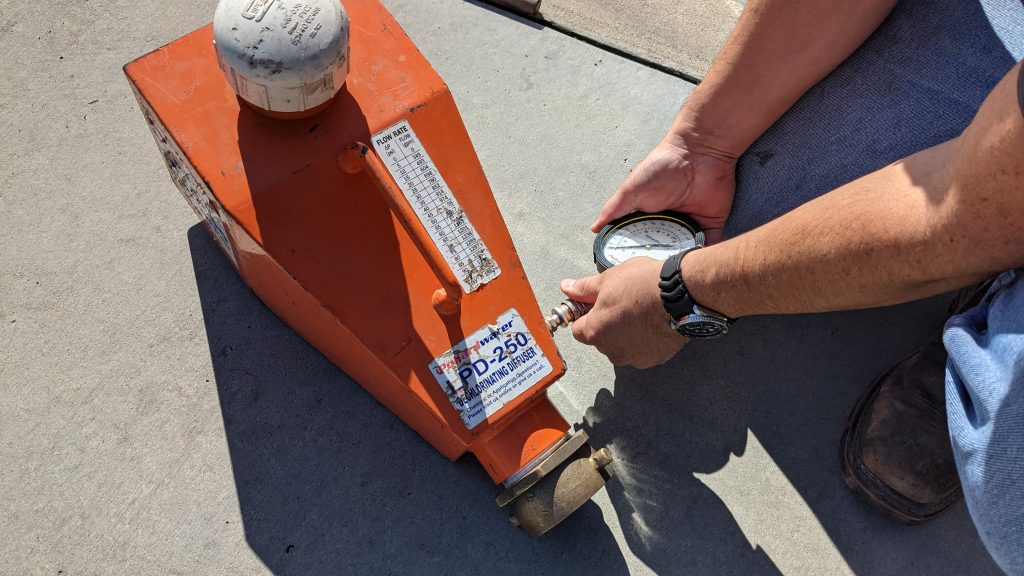
Static pressure: The baseline water pressure in the distribution system when no water is flowing. This establishes the starting condition of the system.
Residual pressure: The pressure measured at the residual hydrant while a nearby flow hydrant is discharging water. This drop in pressure — ideally at least 25% below static — reveals how the distribution system performs under actual demand.
Flow rate: The volume of water discharged during the test, measured in gallons per minute (GPM). Combined with residual pressure, this tells you how much water is available at 20 PSI — the standard firefighting benchmark.
Together, these three numbers give a complete picture of your system's real-world water supply capacity.
Why the 20 PSI Benchmark Matters for Firefighting
NFPA 291 calculates available flow at 20 PSI residual pressure because that's the minimum pressure at which fire apparatus can effectively pump water. Below 20 PSI, a hydrant can't reliably deliver water at the volumes needed to fight a structure fire. A hydrant that looks functional may still be underpowered — and a flow test is the only way to know.
Schedule Your Fire Hydrant Flow Test
Don't wait until your AHJ sends a notice. Red Beacon's licensed team serves commercial, HOA, and industrial properties throughout Southern California and Arizona. Call 855-202-2966 or request a free quote today.
NFPA 25, NFPA 291, and California's Compliance Requirements
Fire hydrant compliance in California isn't optional — and it's not the utility's responsibility. Once a hydrant is on private property, the obligation falls to the property owner or manager.
Annual Hydrant Inspection vs. Five-Year Flow Test
Under NFPA 25 (Standard for the Inspection, Testing, and Maintenance of Water-Based Fire Protection Systems), private fire hydrants must receive a full operational inspection, flush, and flow test annually. This annual test documents static pressure, residual pressure, and flow rate, with results retained and available for fire department review.
In addition to annual testing, California regulations require a full five-year flow certification for minimum water flow — a more rigorous evaluation that verifies the hydrant meets code-minimum performance thresholds. Your local AHJ may also require additional testing intervals based on occupancy type or risk classification.
California Title 25 — Private Hydrant Testing Every Five Years
California Code of Regulations Title 25, Section 1317 requires that private fire hydrants be tested and certified for minimum water flow at least once every five years. This five-year certification must be submitted to the enforcement agency and the fire agency responsible for fire suppression in the area. Properties that don't maintain current certifications risk code violations, failed inspections, and insurance complications.
Red Beacon handles both annual NFPA 25 testing and five-year certification — with documentation submitted directly to your AHJ.
What Your AHJ Expects — and How We Document It
After every flow test, Red Beacon produces a complete certified report including static pressure readings, residual pressure readings, flow rate (GPM), hydrant condition notes, and color classification per NFPA 291. We handle direct AHJ submission so you're not left navigating the paperwork.
Who Needs Fire Hydrant Flow Testing?
Any property with a private fire hydrant is subject to NFPA 25 annual testing requirements and California's five-year flow certification mandate. That covers a wide range of property types across Southern California and Arizona.
Office buildings, warehouses, manufacturing facilities, retail centers, and mixed-use developments with on-site fire hydrants are required to maintain annual testing schedules. Flow test data is also a key input for fire protection engineers designing or modifying fire sprinkler systems — if your system is being upgraded or your building is changing occupancy, a current flow test is typically required before design work begins.
What Happens During a Red Beacon Flow Test
Step-by-Step — What Our Technicians Do On-Site
1. Site assessment: Our technician identifies the residual hydrant and flow hydrant locations per NFPA 291 test layout guidelines.
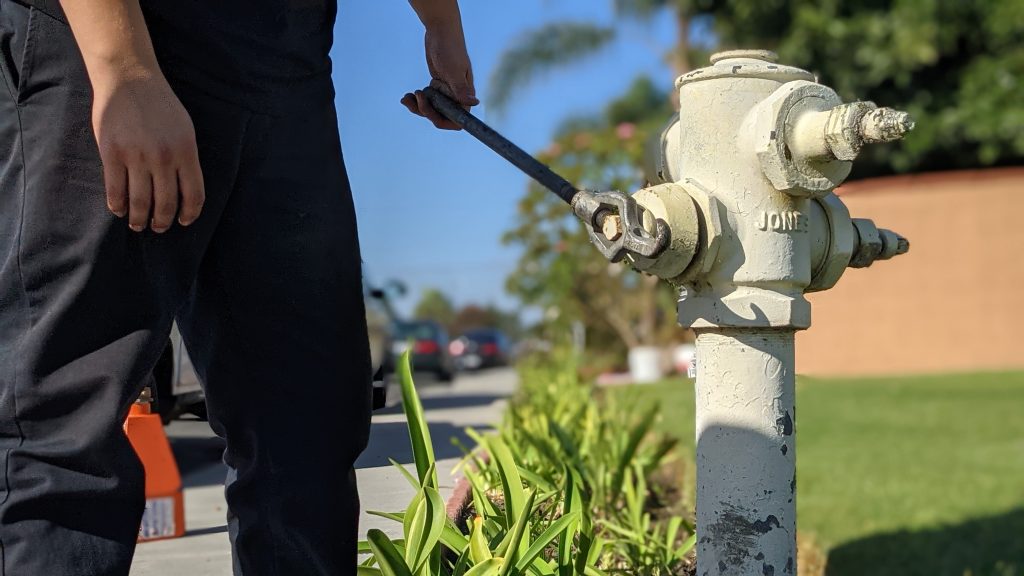
2. Baseline readings: We attach a calibrated gauge to the residual hydrant and record static pressure — the system's baseline before any water flows.
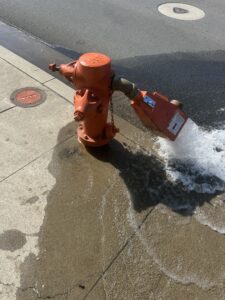
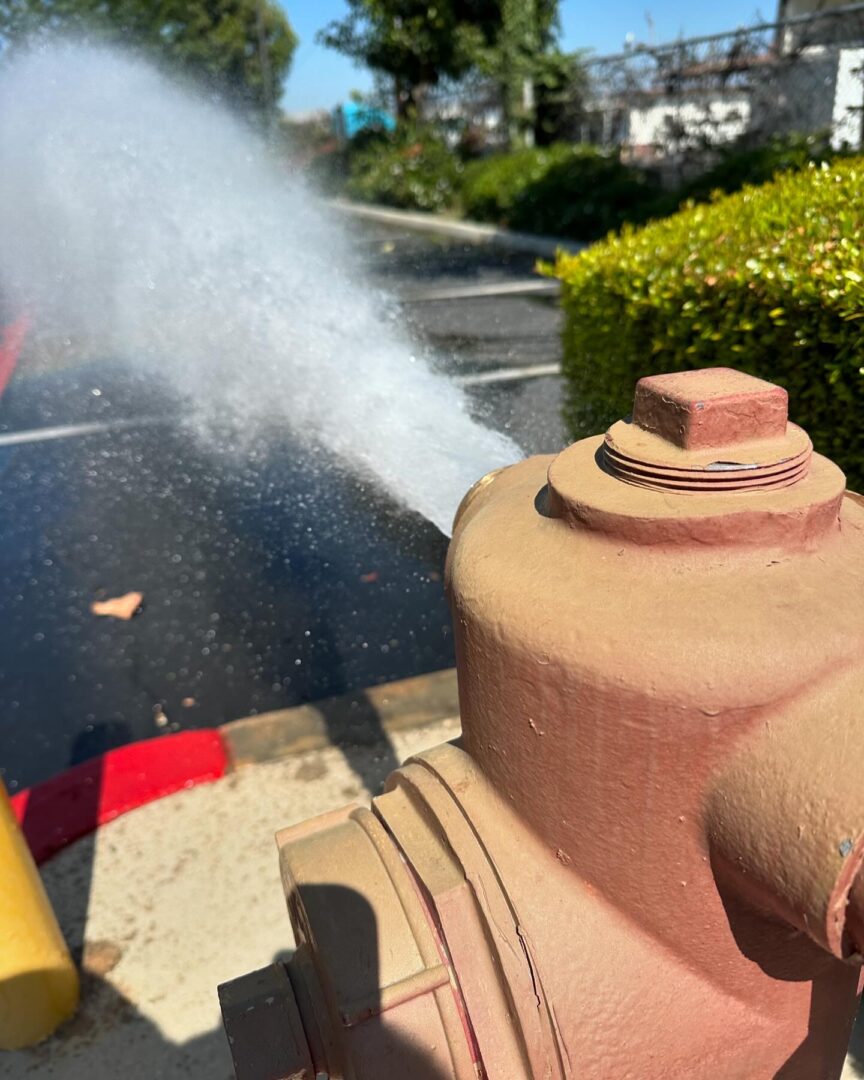
3. Flow discharge: The flow hydrant is opened fully and water is discharged. We capture pitot pressure readings at the flow hydrant to calculate GPM.
4. Residual measurement: Simultaneously, residual pressure is measured at the residual hydrant. We confirm the required 25% pressure drop for a valid test result.
5. Hydraulic calculation: Available flow at 20 PSI is calculated using standard NFPA 291 formulas.
6. Color classification: Based on results, the hydrant is classified and marked per NFPA 291 (see color coding section below).
7. Certified report: We compile all readings, calculations, and findings into a certified flow test report — ready for your AHJ, insurer, or design engineer.
From First Call to Certified Report
Contact Red Beacon → We gather property details and schedule the test → Our licensed technicians complete the on-site flow test → You receive a certified NFPA 291 report → We submit documentation directly to your AHJ.
Most standard flow tests are completed in a single site visit. Report turnaround is fast so you're not waiting on compliance documentation.
What We Find — Common Problems Identified During Flow Testing
A flow test does more than check a box. It reveals the actual condition of your water distribution system. Common issues discovered during testing include:
Faulty or partially closed valves
Valves that haven't been exercised regularly can stick in a partially closed position, restricting flow without any visible external sign. A flow test will catch this where a visual inspection won't.
Wall deposits and tuberculation
Valves that haven't been exercised regularly can stick in a partially closed position, restricting flow without any visible external sign. A flow test will catch this where a visual inspection won't.
Flow deficiencies
Hydrants may test below the minimum threshold for your building type or sprinkler demand, so your system can't deliver the water it's designed around. Early detection gives you time to address the issue.
Hydrant mechanical failures
Gaskets, packing, and internal components degrade over time. Testing identifies leaks, slow-opening valves, and other mechanical issues that require repair.
Fire Hydrant Flow Testing Across Southern California and Arizona
Red Beacon provides fire hydrant flow testing throughout Southern California and Arizona, with established AHJ relationships across all major jurisdictions we serve.
Orange County
We serve all Orange County cities including Anaheim, Santa Ana, Irvine, Huntington Beach, Fullerton, Garden Grove, Orange, Costa Mesa, Mission Viejo, and surrounding communities. Orange County properties fall under OCFA and city fire department jurisdiction — we're familiar with local reporting requirements across all OC municipalities.
Los Angeles County
From Long Beach and Torrance to Pasadena and the San Gabriel Valley, Red Beacon serves commercial and industrial properties throughout LA County. Properties in LA City limits are subject to LA City Fire Department requirements including Fire Chiefs Regulation 4 reporting — we handle that submission directly.
Riverside and San Bernardino Counties
The Inland Empire's rapid commercial and industrial growth means a high volume of new construction flow testing and compliance testing for existing facilities. We serve Riverside, San Bernardino, Ontario, Rancho Cucamonga, Temecula, Murrieta, and surrounding areas.
San Diego County
We serve commercial, industrial, and HOA properties throughout San Diego County, from the city of San Diego north through Escondido, El Cajon, Chula Vista, and Carlsbad.
Arizona
Red Beacon holds an Arizona ROC license (ROC #335591) and serves commercial and industrial properties in the Phoenix metro area and surrounding Arizona markets. Arizona AHJ requirements vary by municipality — our team is familiar with local compliance expectations and handles reporting accordingly.